How Private Credit Moved Through Bank Earnings Calls
Published June 25, 2026 by Jamie
From private-market plumbing, to explicit competition, to NDFI/NBFI exposure mapping.
Private credit did not enter bank calls as a simple banks-versus-nonbanks disruption story. It appeared first through the financing rails and client language of private markets, then through explicit private-credit competition, and finally through NDFI/NBFI exposure disclosure.
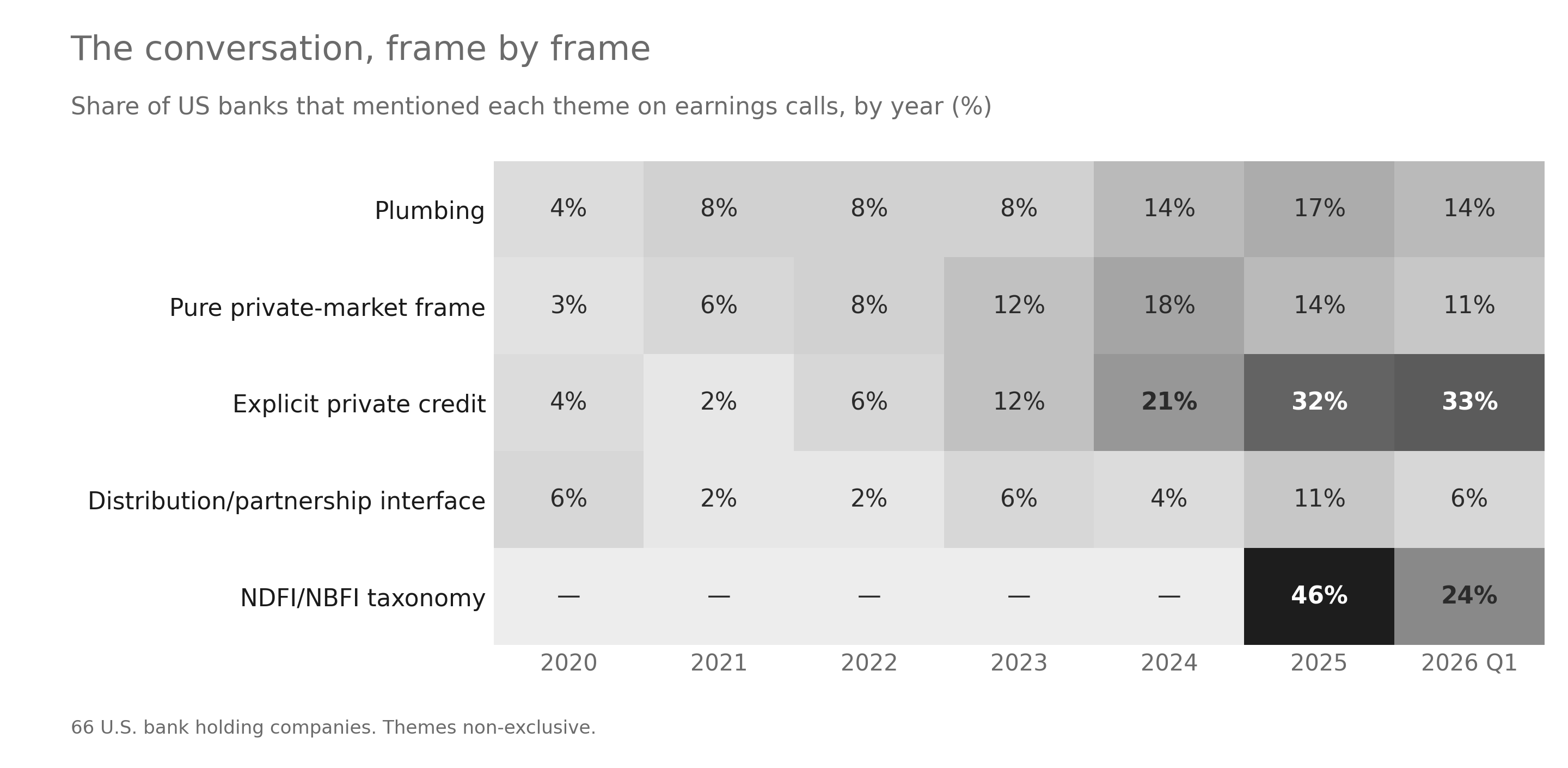 Methodology note: figures show the share of bank holding companies with at least one matching transcript mention in each theme during the period. Themes are non-exclusive: a single call can match several themes, so the shares do not sum to 100%. The 2026 row includes only Q1 indexed transcripts and is not full-year comparable.
From plumbing to exposure: what banks actually said, period by period
| Period | Frame becoming more visible | What the evidence shows |
|---|---|---|
| 2020-2022 | Private-market plumbing before the private-credit label. The transcript language is led by fund finance, subscription lines, and capital calls, with only scattered use of private markets, private capital, or private credit. | State Street in the quarter ended March 31, 2020 described a large fund finance book where the biggest component was capital call financing, emphasizing oversight and diversification rather than a broader private-credit narrative . Western Alliance in the quarter ended March 31, 2022 said demand was strong for subscription lines and capital call lines, again framing the opportunity as financing infrastructure rather than an explicit private-credit theme . |
| 2023 | Private-market client language and explicit private credit start to matter. In 2023, banks began talking more directly about private markets, private capital, and especially private credit as named growth areas rather than just financing plumbing. | Goldman Sachs in the quarter ended September 30, 2023 said client interest in alternatives was broad-based and highlighted significant opportunity in private credit, including private credit vehicles . By the quarter ended December 31, 2023, PNC was explicitly discussing lending shifting into private hands, while JPMorgan said it was enhancing its ability to compete directly with private credit providers and unitranche structures when clients want speed and certainty . |
| 2024 | Explicit private credit becomes clearer; interface examples remain selective. By 2024, private credit was no longer just a label; it had become a more concrete competitive and strategic reference point. | Fifth Third in the quarter ended September 30, 2024 said private credit was showing up at the margins in leveraged lending, with faster execution and less structure affecting market behavior . Webster in the quarter ended June 30, 2024 tied its strategy directly to a private credit offering for sponsor clients . JPMorgan in the quarter ended September 30, 2024 discussed expanding capacity and several co-lending collaborations, showing how the distribution/partnership interface was developing at selected banks . |
| 2025 | NDFI/NBFI exposure taxonomy becomes the dominant disclosure frame, alongside broader explicit private credit. In 2025, management teams increasingly recast the discussion through NDFI/NBFI exposure buckets, while private credit remains a central underlying topic. That shift is consistent with two catalysts: the 2024 U.S. Call Report revisions, effective December 31, 2024, which required banks above $10 billion to itemize NDFI exposure; and the September 2025 failures of First Brands and Tricolor, followed by JPMorgan’s October 2025 “when you see one cockroach…” warning, which sharpened investor scrutiny around nonbank credit. The timing is notable: the NDFI/NBFI column jumps to 46% in 2025. | Truist in the quarter ended September 30, 2025 broke down its NDFI exposure into REITs, asset securitization, capital calls, leasing, BDCs, and mortgage warehousing, emphasizing diversification . Fifth Third in the same quarter detailed NDFI categories including subscription facilities and private capital warehouse facilities . Webster said the proliferation of private credit had slowed sponsor-finance growth and linked its stance to underwriting discipline . |
| 2026 Q1 only | Directional continuation: explicit private credit stays elevated and NDFI/NBFI exposure taxonomy remains prominent. In the quarter ended March 31, 2026, the 2025 pattern continues, but this is only a first-quarter read and not full-year comparable. | JPMorgan explicitly walked investors from headline NBFI balances to a smaller core exposure set and said roughly $50 billion of that core exposure related to private credit . PNC said investor attention was centered on NDFIs and specifically on private credit within that bucket, while maintaining that it did not see meaningful loss content in the book . Fifth Third said it had deliberately kept lending to private credit vehicles and BDCs below 1% of total loans because those structures are harder to assess through a cycle . |
Five shifts and what they mean
| What changed | Why it matters |
|---|---|
| Private credit first appeared through private-market plumbing | The story begins with banks financing fund infrastructure, not just losing loans to nonbanks. |
| Private-market/client language broadened before the label peaked | Banks were already describing private capital as a client ecosystem before “private credit” became the dominant phrase. |
| The explicit private-credit label rose in 2023-2025 | The conversation moved from adjacent infrastructure to named competition and market migration. |
| Distribution/partnership interface became visible, but not universal | Partnerships, flow agreements, fund relationships, and underwrite-to-distribute models complicate “banks vs. private credit,” but they are concentrated in specific banks and business models. |
| NDFI/NBFI became the late-stage disclosure frame | By 2025, the question shifted toward exposure mapping: what kind of nonbank exposure, what structure, what collateral, and what loss position. |
The next question is not simply whether banks are exposed to private credit. It is where they sit in the chain: financing fund plumbing, serving private-market clients, competing for the loan, distributing risk, or explaining NDFI/NBFI exposure.
Want to search and compare bank commentary, filings, and financial data yourself? Request access to BankAnalysis.
Search strings used for the count table
The count table uses narrow search strings rather than broad semantic classification. That reduces false positives, but it also means the percentages should be read as directional indicators rather than exhaustive counts.
- Private-market plumbing: fund finance; subscription finance; subscription line; capital call
- Private-market client language: private market; private capital; private capital sectors; private markets clients; private market strategy
- Explicit private credit: private credit
- Distribution/partnership interface: private credit fund; private debt fund; private credit vehicle; direct lending strategy; co-lending; underwrite to distribute; originate to distribute; forward flow agreements; flow agreements; distribution platform
- NDFI/NBFI exposure taxonomy: NDFI; NBFI; non-depository financial institution(s); nonbank financial institution(s)